
This is general information, not legal advice. For a dispute with a neighbor, talk to a North Carolina attorney or your insurance agent.
Short answer
North Carolina has no statute on falling trees, so courts decide these cases under ordinary negligence law. There is no rule that says “it’s your tree, you pay.” A tree owner is responsible only if they should have seen the danger and didn’t deal with it. And whoever is at fault, your own homeowners insurance is usually the first place to go for damage to your house.
When the tree owner is responsible
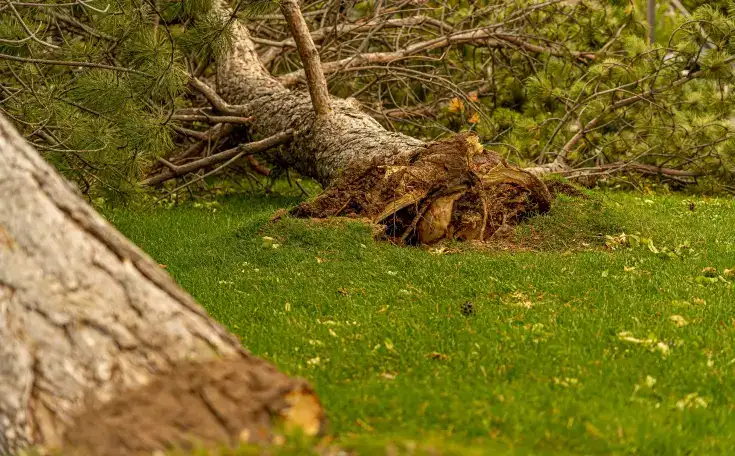
A landowner has a duty to deal with dangers to neighboring property that they could reasonably foresee. NC State Extension lists the kinds of signs that count:
- The tree was dead or visibly dying.
- It had a pronounced lean toward the neighbor’s property.
- Long limbs reached across the line, especially over parked cars or buildings.
- Someone cut through a large anchoring root, for example while digging or grading.
If the owner knew, or should have known, about a problem like that and waited, they may be liable. Whether the fall was foreseeable is a question a judge or jury decides from the facts.
Storms and “acts of God”
A healthy tree brought down by a hurricane or a violent storm usually doesn’t make its owner liable. But a storm acting on a tree that was already weak can be foreseeable. After Helene, many trees in Buncombe County were left cracked, leaning or with lifted roots. A tree like that, left standing for months, is the kind of known hazard that can shift responsibility to the owner.
Whose insurance pays
For damage to your house, garage or other insured structure, your own homeowners policy generally pays, no matter who owned the tree, minus your deductible. If the neighbor was negligent, your insurer can try to recover the cost from them or their insurer, and you may get your deductible back. Fault matters most when someone has no insurance or a lapsed policy. See does homeowners insurance cover tree removal? for the limits on removal costs.
What to do first
- Get safe. Keep everyone away from the damaged part of the house. If a power line is involved, stay back and call 911 or Duke Energy.
- Take photos of the tree, the stump or root plate, and all the damage before anything is moved.
- Call your insurance company to start the claim, and tell your neighbor.
- Get the tree off the house. Call us 24/7 at 828-367-9685. We cut it off in sections so it doesn’t do more damage, and send an itemized invoice with photos for the claim. See emergency tree service.
Worried about a neighbor’s tree that hasn’t fallen yet?
Talk to your neighbor first. A dated letter or email with photos shows the danger was pointed out. If you want an outside opinion on whether a tree is a risk, a tree health assessment gives you a plain answer you can share. And if it’s your tree leaning toward a neighbor, removing or pruning it now is far cheaper than a claim later.
Sources: NC State Extension, R. Branan,Tree Fall Liability: Who Is Responsible for Property Damage? (April 2022); Ward and Smith, The Law of Fallen Trees; Insurance Information Institute, If a tree falls on your house, are you covered?