Hemlock woolly adelgid
A tiny insect that leaves white, cottony tufts under hemlock needles. It has killed many hemlocks across Western North Carolina, and dead hemlocks become brittle fast.

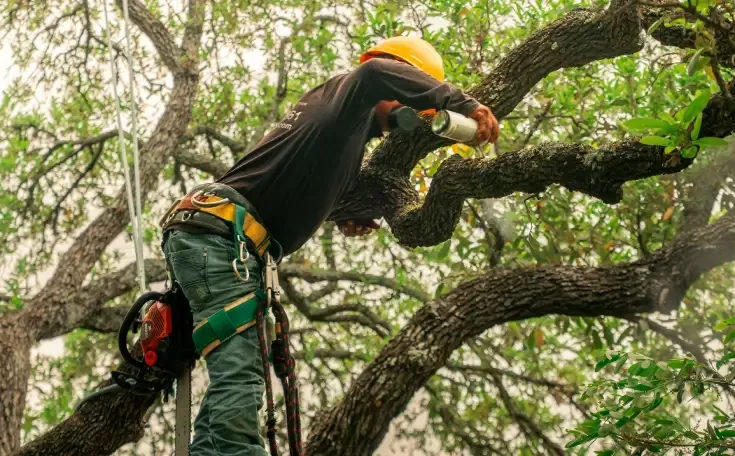
We check for disease, pests and structural weak points, and tell you plainly what needs doing and what can wait.
Big trees add value, shade and beauty to your property, until one starts to fail. A tree health assessment tells you which trees are healthy, which ones need care, and which are a risk to your home or family.
We are not in the business of selling removals you don’t need. If a tree can be saved with pruning or some care, we will say so. If it is a hazard, we will explain why and what your options are.
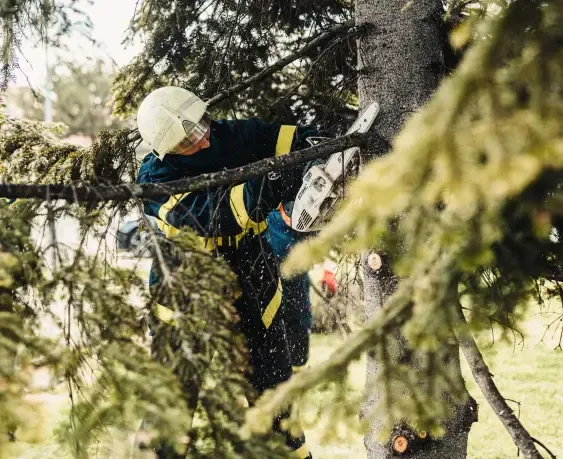
These are the issues we find most often in Asheville yards.
A tiny insect that leaves white, cottony tufts under hemlock needles. It has killed many hemlocks across Western North Carolina, and dead hemlocks become brittle fast.
Thinning tops, bark splitting off and small D-shaped exit holes on ash trees. Infested ash usually dies within a few years and becomes dangerous to remove.
Mushrooms at the base, soft or hollow wood and cavities mean decay inside the tree. Some rot is harmless; some means the tree could fail.
Cracked unions, broken tops, lifted root plates, and roots cut or buried during construction often show up as decline years later.
Tight V-shaped forks, co-dominant trunks and long, heavy limbs are prone to splitting. Structural pruning can often fix them.
Early leaf drop, spots, wilting and thin canopies can mean disease, drought stress or root problems.
Next steps: Pruning & deadwood removalHazardous tree removal
No pressure and no jargon.
Tell us which trees you are worried about and why.
We check the canopy, trunk, roots and soil for disease, pests, decay and weak structure.
You get our findings and a written estimate for anything that should be done.
We help homeowners and businesses protect their property with tree work done safely, efficiently and with the tree’s long-term health in mind.
Our trained crew follows professional tree care and safety standards on every job.
We protect your lawn, deck and driveway, and leave the site cleaner than we found it.
Storm damage can’t wait. We answer the phone and get a crew moving, day or night.
Proof of insurance on request and a clear written estimate before any work starts.
"After a big storm took down a 60-foot oak right next to our house, I was panicking. These guys were out the same evening, had it safely removed by the next morning, and left the yard spotless."
"We had three huge trees removed from our backyard, one right over the deck. I was nervous about damage, but the crew was meticulous. They used ropes and rigging and not a single branch touched anything."
"They trimmed all eight of our mature maples and did an outstanding job shaping them. The arborist explained everything beforehand and clearly cared about the health of the trees, not just getting done fast."
We look at the canopy, trunk, root flare and the soil around the tree, check for disease, pests, decay and structural weak points, and tell you plainly what needs doing now and what can wait.
No one can predict exactly when a tree will fail, but most failures show warning signs first: cracks, decay, leaning, root damage or dead limbs. We look for those signs and tell you how serious they are.
Often, yes, if the problem is caught early. Pruning out diseased wood, improving the soil and treating some pests can add years to a tree’s life. When a tree is too far gone or a real risk, we will tell you honestly.
It is a good idea, especially for large trees near the house. An assessment tells you what work may be coming so you can plan for it.
Large trees near your house, driveway or play areas should be checked every year or two, and after any major storm.
Based on Haywood Road in West Asheville, we cover Asheville and Buncombe County. Not sure if we cover your area? Give us a call at 828-367-9685.
Book an assessment and get a straight answer about what it needs.